
The Weekend Hack That Shook Enterprise Security
For years, people have been impressed by what AI chatbots can do — but frustrated by what they cannot. ChatGPT can write a professional email with perfect tone and grammar, but you still have to copy, paste, and hit send yourself. OpenClaw changes that equation entirely. It doesn’t just draft the email. It sends it. It doesn’t just suggest a meeting time. It schedules it. For the first time at scale, ordinary users can delegate not just thinking, but doing.
But the very capability that made OpenClaw irresistible — autonomous action — is also what makes it extraordinarily dangerous in an enterprise environment. The OpenClaw crisis is not merely a story about one piece of software. It is the opening chapter of a much larger reckoning: the moment enterprise security teams were forced to confront what it means when AI doesn’t just advise, but acts.
The Invisible Threat Already Inside Your Network
The scale of OpenClaw’s deployment would be alarming under any circumstances. With over 135,000 publicly exposed instances identified by security researchers, it represents one of the largest uncontrolled security risks in enterprise IT history. What makes it uniquely dangerous is how it got there: not through official IT procurement, but through the back door.
What OpenClaw Can Access — and What That Means
To understand the risk, consider what a default OpenClaw installation requests access to when an employee sets it up on a corporate machine:
- Full read and send access to the employee’s email account
- Calendar read and write permissions (including creating and accepting meeting invitations)
- Access to connected cloud storage (Google Drive, OneDrive, SharePoint)
- Slack, Teams, and other messaging platform integrations
- Browser history and the ability to perform autonomous web browsing
- Code execution capabilities on the local machine
Now multiply that by the number of employees who have quietly installed it across your organisation. Each one represents a fully autonomous agent operating inside your network perimeter, with broad data access, and zero oversight from your security team.
A Malware Distribution Network in Disguise
If the base OpenClaw application represents a serious security risk, the ClawHub marketplace — where users download third-party “skills” to extend their agent’s capabilities — elevates that risk to a different order of magnitude entirely.
Skills are plugins that grant OpenClaw new abilities: integrating with additional services, executing specialised workflows, accessing new data sources, or automating complex multi-step processes. The concept is powerful. The security setup is, to put it charitably, catastrophic.
Security professionals have spent years educating developers about the risks of blindly installing npm packages from unknown authors. The OpenClaw skills ecosystem presents an identical problem — with the additional twist that these packages can execute arbitrary commands with AI-driven autonomy, not just run as a passive dependency.
Partial Fixes Are Not Enough
Although project founders require that skill authors have a GitHub account at least one week old before uploading, and a community flagging mechanism exists for malicious uploads, these are still not sufficient controls for any environment with serious data sensitivity. Enterprises cannot rely on the goodwill of an open-source community as their primary security control for AI agents handling sensitive corporate data.
Those third-party skills in ClawHub can request system-level permissions including shell command execution. A malicious skill can exfiltrate data, stay hidden in your system, or attack other parts of your network — all via the trusted channel of your AI agent, which your other security tools may be configured to allow.
WISEAI BeWise SLM and Enterprise AI Agents
The OpenClaw crisis did not reveal a problem with AI agents. It revealed a problem with ungoverned AI agents. The distinction matters enormously — because the solution is not to abandon the productivity revolution that agentic AI represents, but to deploy it on a foundation that was built with enterprise security as a first principle, not an afterthought.
That is precisely the problem that WISEAI BeWise SLM was designed to solve.
WISEAI BeWise SLM (Small Language Model) is an enterprise-grade AI agent platform purpose-built for organisations that need the productivity benefits of agentic AI without the security compromises of open-source alternatives like OpenClaw. Unlike general-purpose consumer AI tools retrofitted for enterprise use, BeWise SLM was architected from the ground up around the security, compliance, and governance requirements of regulated industries.
At its core, BeWise SLM combines a highly capable small language model — optimised for enterprise tasks with a far smaller footprint than large public models — with a robust agent framework that enforces governance controls at the architectural level, not the policy level.
Security Architecture: Built Different
Where OpenClaw’s security story is a patchwork of community fixes applied to an architecture that was never designed for enterprise deployment, WISEAI BeWise SLM’s security model is structural:
- On-Premises / Private Cloud Deployment: BeWise SLM runs entirely within your own infrastructure. Your data never leaves your network boundary. There is no call to an external API, no third-party model provider with access to your queries, no cloud dependency that becomes a vector for exfiltration.
- Granular Permission Controls: Every agent capability is individually permissioned through an enterprise IAM integration. The agent does exactly what it is authorised to do — nothing more.
- Immutable Audit Trails: Every action taken by every BeWise SLM agent is logged to an immutable audit trail with full context: who initiated the action, what data was accessed, what decision was made, and what outcome resulted. Compliance teams have complete visibility.
- Zero Third-Party Plugin Marketplace: BeWise SLM has no equivalent to ClawHub. Extensions and integrations are developed, reviewed, and approved through a formal enterprise software governance process
- Action Verification Layer: Inspired by architectural proposals like the Action Control Protocol, BeWise SLM’s agent framework includes a built-in verification layer that reviews proposed actions against defined policy rules before execution.
The SLM Advantage: Why Smaller Is Safer
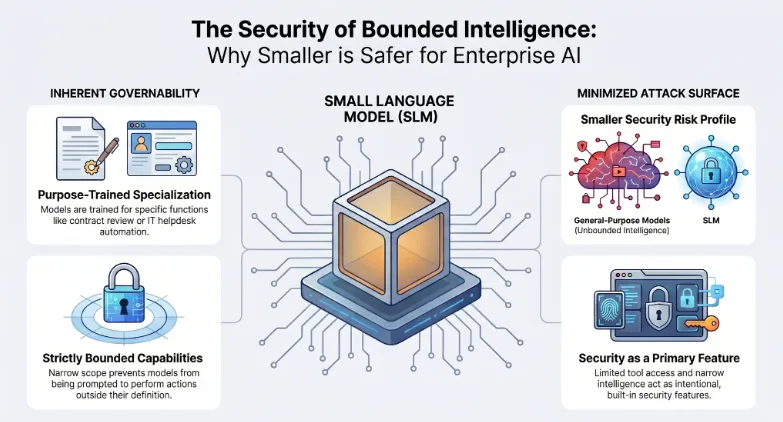
One of the counterintuitive advantages of the Small Language Model architecture is that smaller, purpose-trained models are inherently more governable than large general-purpose models. A BeWise SLM agent trained for a specific enterprise function — contract review, customer support triage, IT helpdesk automation — has a tightly bounded capability set. It cannot be prompted to perform actions outside its defined scope the way a general-purpose model can.
This bounded capability is not a limitation — it is a security feature. The attack surface of an agent that can only do what it was explicitly designed to do is vastly smaller than an agent with broad, general intelligence and unrestricted tool access.
Regulatory Compliance Out of the Box
For organisations operating in regulated industries — financial services, healthcare, legal, government — the compliance dimension of AI agent deployment is as important as the security dimension. BeWise SLM ships with pre-built compliance templates for major regulatory frameworks:
- GDPR / PDPA: Data residency controls, strict data controls, automated privacy rights processing
- ISO 27001 / SOC 2: Audit trail generation, access control documentation, incident response integration
These are not checkbox compliance features. They are enforced at the architectural level, generating the evidence your auditors need automatically, as a byproduct of normal operations.
Conclusion
The OpenClaw story is a cautionary tale, but it should not be read as an argument against agentic AI. The productivity potential of AI agents that can take autonomous action — scheduling, drafting, researching, executing — is real and significant. Organisations that learn to deploy this capability safely will gain a durable competitive advantage.
The lesson of OpenClaw is not that AI agents are too dangerous to use. The lesson is that ungoverned AI agents — deployed without proper security architecture, without identity controls, without audit trails, without a safe extension ecosystem — introduce risks that no enterprise should accept.
WISEAI BeWise SLM represents the answer to the question that the OpenClaw crisis forces every enterprise technology leader to confront: how do we capture the promise of agentic AI without inheriting its risks? The answer is to choose a platform where governance is not a feature, but the foundation.